

In precision wire manufacturing, the conversation often centers around shape, tolerance, and material selection. But one critical factor that directly impacts performance—yet is often overlooked—is annealing.
For manufacturers using shaped wire in demanding applications, understanding the role of annealing can make the difference between a component that performs reliably and one that could fail. Let’s break it down:
What Happens to Wire During Shaping?
When wire is cold worked—through techniques such as rolling, drawing, or shaping—it undergoes significant changes at the structural level.
As the material is formed:
- The grain structure becomes elongated
- Internal stresses build within the material
- Hardness increases
- Ductility decreases
While increased hardness can be beneficial in some cases, excessive work hardening can make the wire brittle, difficult to form further, or prone to cracking under stress.
The Purpose of Annealing
Annealing is a controlled heat treatment process used to restore balance to the material.
By heating the wire to a specific temperature and allowing it to cool under controlled conditions, annealing:
- Relieves internal stresses caused by cold work
- Recrystallizes the grain structure
- Restores ductility
- Reduces hardness to a desired level
The result is a wire that is not only easier to work with, but also more predictable and reliable in its final application.
Why Annealing Is Especially Important for Shaped Wire
Shaped wire introduces additional complexity compared to round wire.
Because the geometry is more intricate:
- Stress may be distributed unevenly during forming
- Certain areas may experience more deformation than others
- Tight tolerances leave less room for material inconsistency
Annealing ensures that the wire maintains uniform mechanical properties across its entire profile, which is critical for:
- Spring performance
- Forming operations
- Medical components like catheter braiding wire
- Precision assemblies requiring repeatability
Matching the Process to the Application
Not all annealing approaches are the same. The right method depends on the material, geometry, and end-use requirements.
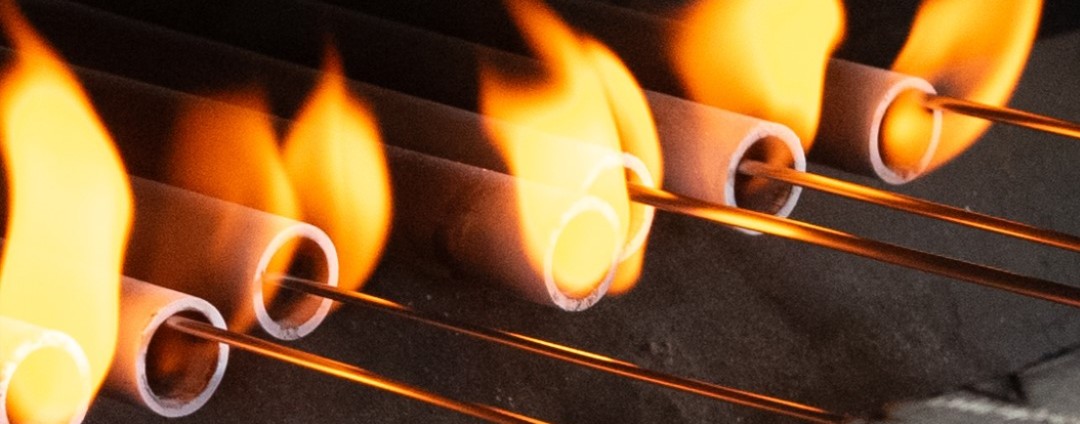
At United Wire, annealing capabilities include:
Strand Annealing
A continuous process ideal for producing long lengths of wire with consistent mechanical properties throughout the coil. This method is especially well-suited for high-volume applications where uniformity is critical.
Batch Annealing
A controlled process used for specific quantities or specialized requirements, allowing for precise thermal cycles based on material and performance needs.
*Inert Gas Option- Annealing can be performed using an inert gas atmosphere during both strand and batch processes. This helps protect the wire surface, maintain cleanliness, and prevent oxidation. In strand annealing, using an inert gas instead of hydrogen also eliminates the risk of hydrogen embrittlement—an important consideration in high-performance and critical applications.
*United Wire also offers age hardening, a controlled heat treatment used to increase strength and hardness after forming by optimizing the material’s internal structure.
The Advantage of Continuous, Weld-Free Lengths
One often overlooked benefit of a well-controlled annealing process is the ability to provide long, continuous lengths of wire without welds.
United Wire offers:
- Continuous annealed lengths up to 1,000 lbs
- No welds
This is particularly valuable in applications where:
- Consistency is critical
- Weld points could introduce weak spots
- Downtime from spool changes needs to be minimized
Annealing as a Performance Driver
Annealing isn’t just a secondary step—it’s a key part of engineering the final performance of the wire.
By controlling the mechanical properties after shaping, manufacturers can:
- Improve formability in downstream processes
- Enhance fatigue resistance
- Ensure consistency from lot to lot
- Reduce the risk of failure in critical applications
Partnering for the Right Outcome
Choosing the right wire supplier means more than sourcing material to a print. It means working with a partner who understands how every step in the process—from shaping to annealing—impacts your final product.
At United Wire, annealing is not an afterthought. It’s an integrated part of delivering precision-shaped wire that performs exactly as intended. To discuss more, contact us at sales@unitedwirecompany.com or call 1-800-840-9481