

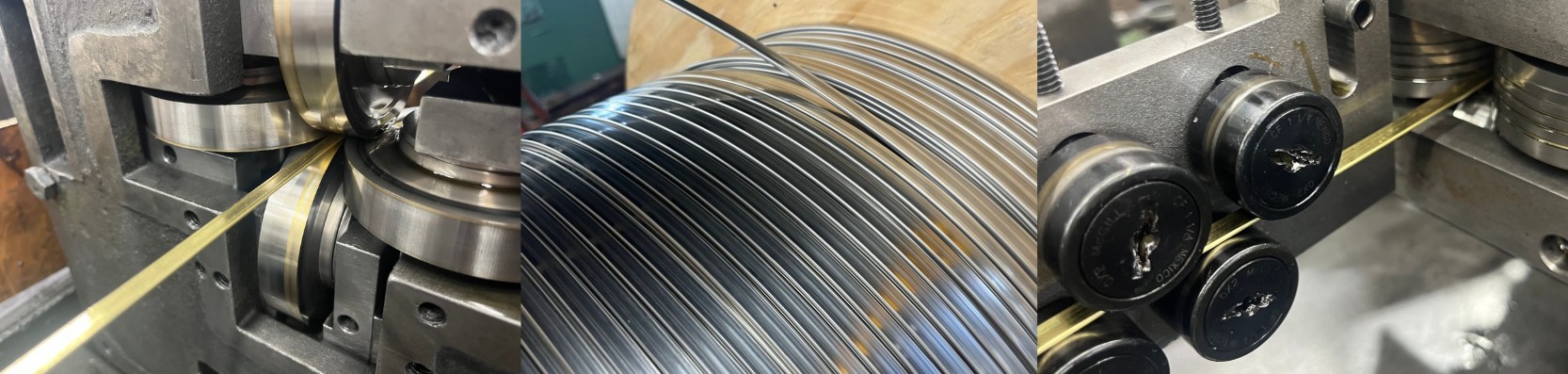
When specifying wire for a project, one of the most important—and often overlooked—decisions is how that wire is processed. For manufacturers focused on precision, consistency, and performance, this choice can have a significant impact on the final product.
While both hot rolled and cold rolled wire have their place, understanding the differences between the two can help ensure you select the right material for your application.
What Is Cold Rolled Wire?
Cold rolled wire is produced by processing material at or near room temperature through a series of specialized rolls, often made from tool steel or carbide. As the wire passes through these rolls, it is reshaped into precise profiles with tight tolerances and improved surface finishes—all without the use of elevated temperatures.
At companies like United Wire Company, this process is used to transform standard round wire into highly engineered shapes designed to meet the specific needs of demanding applications.
Cold Rolled vs. Hot Rolled Wire: The Core Difference
The primary difference between cold rolled and hot rolled wire comes down to temperature—and the level of control that temperature allows.
Hot rolled wire is processed at high temperatures, which makes it easier to form (especially complex shapes), but also less precise. This often results in looser dimensional tolerances and a rougher surface finish (due to mill scale). It’s an efficient method for certain applications, it’s not ideal when precision is critical.
Cold rolled wire, on the other hand, is processed at ambient temperatures. This allows for much greater control over the material, resulting in tighter tolerances, smoother surfaces, and enhanced mechanical properties. While the process is more controlled, the payoff is significantly higher performance.
Why Cold Rolled Wire Stands Out
One of the biggest advantages of cold rolled wire is its ability to maintain extremely consistent dimensions. In industries like automotive, medical devices, electronics, aerospace, and oil and gas, even minor variations can lead to performance issues. Cold rolling minimizes that risk by delivering repeatable, high-precision results.
Another key benefit is the ability to create custom profiles. Instead of being limited to standard round wire, manufacturers can produce flat, square, rectangular, or fully custom shapes using specialized tooling. This flexibility allows engineers to design components that fit better within assemblies, often reducing or eliminating the need for secondary machining processes while improving overall product performance.
Surface quality is another area where cold rolled wire excels. Because the material is not exposed to high temperatures, it retains a cleaner and smoother finish. This can reduce friction in moving parts, improve coating or plating adhesion, and enhance the overall appearance of the final product.
Cold rolling also improves the material’s strength. The process introduces strain hardening, which increases the structural integrity of the wire. In many cases, cold rolled wire can be up to 20% stronger than its hot rolled counterpart, making it a reliable choice for applications where durability and performance are essential.
While cold rolling may involve more precise processing upfront, it often leads to cost savings over time. By minimizing material waste, reducing the need for secondary operations, and improving production efficiency, manufacturers can see meaningful gains in overall cost-effectiveness.
When Does Cold Rolled Wire Make Sense?
Cold rolled wire is the right choice when your application depends on tight tolerances, consistent quality across high volumes, custom shapes, enhanced mechanical properties, or clean surface finishes. In these situations, precision isn’t just a preference—it’s a requirement.
Why This Decision Matters
Choosing between hot rolled and cold rolled wire isn’t simply a material selection—it’s a performance decision. The right choice can influence everything from manufacturability to product reliability.
Cold rolled wire gives engineers more flexibility to design smarter, reduce downstream processing, and create more dependable products. In competitive industries, those advantages can translate directly to improved efficiency and a stronger bottom line.
Final Thoughts
As manufacturing continues to demand higher levels of precision and efficiency, cold rolled wire is an excellent option. Whether you’re developing a new product or refining an existing one, understanding the benefits of cold rolling can help you make more informed—and ultimately more profitable—decisions. For more information, contact the experts at United Wire: sales@unitewirecompany.com